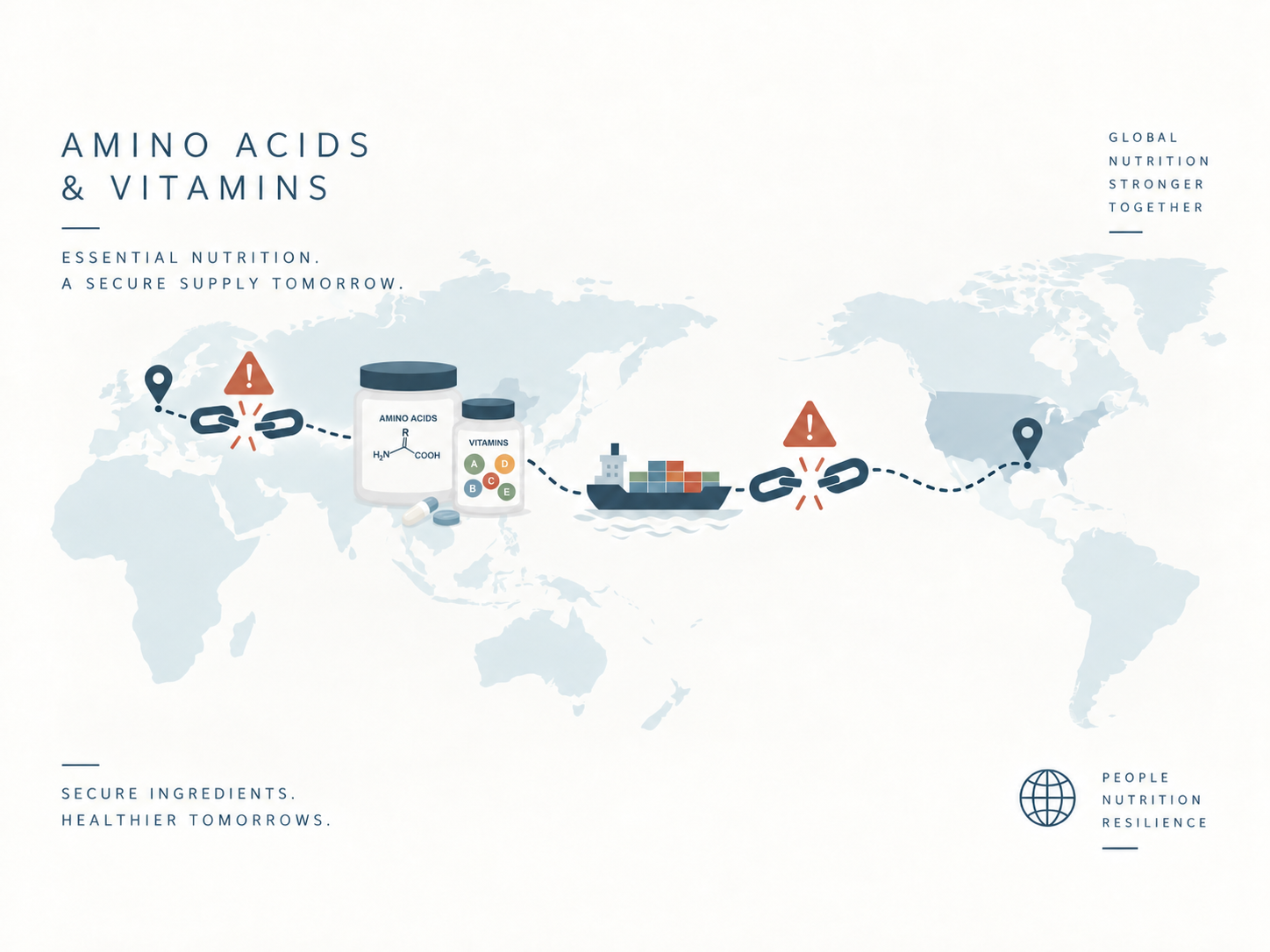
Vitamins and amino acids are usually discussed in the context of nutrition, health, and lifestyle. However, they are also part of global supply chains that are becoming increasingly concentrated. As a result, ensuring a stable supply of these essential nutrients, at a consistently high level of quality, has become a matter of food security and, more broadly, national security.
1. Why vitamins and amino acids matter
Thirteen vitamins are recognized as essential for human health (Table 1). They help the body perform many important functions including supporting the immune system, converting food into energy, and maintaining healthy bones. A varied diet that includes fruits, vegetables, whole grains, protein-rich foods, and healthy fats can provide many of these vitamins.
Table 1. Vitamins necessary for proper human function
| Vitamin | Fat-soluble | Water-soluble |
|---|---|---|
| Vitamin A | ✓ | |
| Vitamin C | ✓ | |
| Vitamin D | ✓ | |
| Vitamin E | ✓ | |
| Vitamin K | ✓ | |
| Vitamin B1 (thiamine) | ✓ | |
| Vitamin B2 (riboflavin) | ✓ | |
| Vitamin B3 (niacin) | ✓ | |
| Vitamin B6 (pyridoxine) | ✓ | |
| Vitamin B12 (cyanocobalamin) | ✓ | |
| Pantothenic acid (vitamin B5) | ✓ | |
| Biotin (vitamin B7) | ✓ | |
| Folate (folic acid or vitamin B9) | ✓ | |
| Source: MedlinePlus, accessed 2026. | ||
| Notes: | ||
| - Fat-soluble vitamins are absorbed more easily by the body in the presence of dietary fat. | ||
| - Water-soluble vitamins are generally not stored in the body. | ||
| - Each vitamin contributes to the development and function of multiple organs and tissues. |
Amino acids are equally important. These are molecules used by all living organisms to build proteins (Table 2). The human body requires 20 different amino acids to function properly and can produce 11 of them, known as nonessential amino acids. The remaining nine are called essential amino acids because the body cannot produce them and must obtain them through food. These essential amino acids are found in foods such as meat, eggs, dairy products, legumes, nuts, and seeds.
Table 2. Essential amino acids and their main functions
| Essential amino acid | Main function |
|---|---|
| Histidine | Helps produce histamine, a neurotransmitter involved in immune function, digestion, and sleep. |
| Isoleucine | Supports muscle metabolism and immune function. |
| Leucine | Helps the body produce proteins and growth hormones. |
| Lysine | Contributes to hormone and energy production. |
| Methionine | Supports tissue growth, metabolism, and detoxification. |
| Phenylalanine | Supports the production of neurotransmitters in the brain. |
| Threonine | Plays an important role in the formation of collagen and elastin. |
| Tryptophan | Helps maintain the body’s nitrogen balance. |
| Valine | Supports muscle growth, tissue regeneration, and energy production. |
| Source: Author’s compilation based on Cleveland Clinic (2021), accessed 2026. | |
| Note: Each amino acid contributes to multiple physiological processes. The table presents only one of the principal functions associated with each amino acid. |
However, not everyone has consistent access to a balanced diet that provides adequate amounts of essential vitamins and amino acids. Diet quality is of increasing concern in many developed countries, while in lower-income countries, this challenge is often compounded by limited access to sufficient food. Although dietary supplements are not a substitute for a balanced diet, they can help address certain nutritional gaps. Yet the availability of supplements, fortified foods, and nutritionally complete animal feed also depends on a stable supply of vitamins and amino acids. This is where nutrition becomes a matter of supply-chain resilience, food security, and more broadly national security.
The security of vitamin and amino acid supplies is therefore attracting greater political attention. On May 20, 2026, members of the U.S. Congress introduced the Dietary Supplements Access Act. If approved, the Bill would allow consumers to use certain tax-advantaged health accounts to purchase dietary supplements. The proposal has not become law, but its introduction suggests that access to dietary supplements is becoming a more prominent policy issue.
2. From personal nutrition to food security
Vitamins and amino acids are not only used in products for humans (e.g. dietary supplements, cosmetics, etc.). They are also added to livestock and poultry feed. These nutrients support animal growth, reproduction, health, and the efficient production of meat, milk, and eggs.
This creates an important connection between vitamin and amino acid supply chains and food security. A disruption in the supply of feed-grade vitamins or amino acids could affect animal health, increase production costs, reduce total farm output and product quality, and eventually influence the availability and price of food. A 2025 assessment by the Institute for Feed Education and Research found that the United States depends heavily on imported vitamins and amino acids for animal feed. Practically all of these imports are from China.
The problem is not trade itself. International trade allows countries to obtain products efficiently and at competitive prices. The risk arises when production is highly concentrated and buyers have few practical alternatives (monopolies or cartels). As Canadian Prime Minister Mark Carney stated in his 2026 address at the World Economic Forum:
“A country that can't feed itself, fuel itself or defend itself, has few options.”
Table 3. Production capacity and U.S. import dependence for selected amino acids and vitamins used in animal feed
| Nutrient | Global capacity (MT) | North American capacity (MT) | North American share of global capacity | U.S. imports from China |
|---|---|---|---|---|
| Lysine | 4,700,000 | 565,000 | 12% | 100% |
| Methionine | 2,300,000 | 385,000 | 17% | 16% |
| Threonine | 1,300,000 | 90,000 | 7% | 85% |
| Tryptophan | 120,000 | 8,500 | 7% | 52% |
| Vitamin A | 27,500 | 0 | 0% | 49% |
| Thiamine (vitamin B1) | 17,100 | 0 | 0% | 93% |
| Riboflavin (vitamin B2) | 15,900 | 0 | 0% | 65% |
| Niacin (vitamin B3) | 133,900 | 10,000 | 7% | No data |
| Pantothenic acid (vitamin B5) | 35,990 | Not reported | Not studied | 85% |
| Pyridoxine (vitamin B6) | 7,998 | Not reported | Not studied | 95% |
| Biotin (vitamin B7) | 388 | 0 | 0% | No data |
| Folic acid (vitamin B9) | 70,960 | Not reported | Not studied | No data |
| Cobalamin (vitamin B12) | 267 | 0 | 0% | 77% |
| Vitamin D3 | 3,639 | 0 | 0% | 0% |
| Vitamin E | 90,000 | 0 | 0% | 80% |
| HS code 293629 (vitamins B3, B9, and D3) | 143,979 | Not reported | Not reported | 47% |
| Source: Author’s adaptation of Institute for Feed Education and Research (IFEEDER, 2025), p. 2. | ||||
| Notes: Capacity figures are expressed in metric tons (MT). The final column shows imports from China as a percentage of total U.S. imports. “Not studied” and “No data” reproduce the classifications reported by IFEEDER. |
The numbers in Table 3 show that the US level of dependence varies by vitamin and amino acid. Dependence is not equally high in every category and these differences matter because each nutrient has its own production process, market structure, and possible substitutes. While this table is specific to North America, European countries are basically in the same situation of dependence and minimal production capacity. More research is needed to understand the situation in developing countries.
3. Vitamin and amino acid production has become highly concentrated
The issue extends beyond livestock feed. According to a 2026 Swissinfo investigation, China produces more than 80% of the global supply of eight of the 13 vitamins essential to humans. It produces more than 90 percent of vitamins B6, B9 (folic acid), B12, biotin, and vitamin C. European manufacturers now hold only a small share of the global vitamin market. The United States essentially has no industrial vitamin production.
This concentration is especially concerning for nutrients with important public-health uses. Folic acid, for example, is recommended before and during pregnancy because it helps prevent serious defects in the development of a baby’s brain and spine. A major supply interruption could therefore impact more than the dietary supplement market, and its effects could last generations.
4. What would happen during a disruption?
A supply disruption would not necessarily produce an immediate shortage of every vitamin or amino acid. Companies might draw from existing inventories, purchase from alternative suppliers, reformulate animal feed, or temporarily reduce the number of certain supplements used.
However, these responses have limits. Alternative suppliers may not have enough capacity to meet a sudden increase in demand. New production facilities are expensive and can take years to build, while recruiting and training the specialized personnel needed to operate them can create further delays. Feed formulations can also be changed only to a certain extent before animal health and productivity begin to suffer.
Thus, the effects of a supply disruption would depend on several factors:
- Which vitamin or amino acid became unavailable?
- How long will the disruption last?
- Wha is the amount held in public and private inventories?
- Do suitable substitutes exist?
- How quickly can production be expanded elsewhere?
- Which livestock sectors are most dependent on the affected vitamin or amino acid? These questions require more research.
5. Should production return to North America and Europe?
Bringing some production back to North America and Europe could reduce dependence on a single foreign source. However, rebuilding industrial capacity would involve significant economic, political, technical, and environmental challenges.
Production in China may benefit from lower costs, greater industrial scale, established supplier networks, and government support. New Western facilities would need to compete against these advantages while meeting stricter labor and environmental standards. Reshoring is also not the only option. Governments and businesses could combine several approaches, including:
- Expanding production in North America and Europe
- Developing suppliers in additional countries
- Maintaining strategic reserves of critical nutrients
- Supporting research into alternative production methods
- Creating long-term purchasing agreements with trusted suppliers
- Monitoring supply concentration and trade disruptions
- Coordinating policies with international partners
6. A research agenda for a recently discovered vulnerability
The concentration of vitamin and amino acid production raises questions that connect nutrition, agriculture, trade, industrial policy, and national security.
Future research should identify which vitamins and amino acids are most vulnerable to a supply shock, how long existing inventories could support human and animal needs in case it happened, and which set of policies would encourage greater production. It should also examine the cost of improving resilience and determine how best to pay for it.
7. In conclusion
Vitamins and amino acids may represent only a small part of the total volume of food and animal feed. Their importance, however, is much greater than their physical size. Without reliable access to these nutrients, the effects could spread throughout public health, livestock production, and food quality. The central question is therefore not whether North America and Europe should produce every vitamin and amino acid they use. It is whether their current level of dependence leaves them dangerously exposed and what combination of production, trade, strategic reserves, and international cooperation could reduce that risk.
References
- https://medlineplus.gov/ency/article/002399.htm
- https://my.clevelandclinic.org/health/articles/22243-amino-acids